
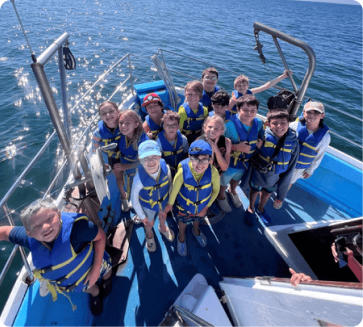
Spend time on research vessels, collect sea creatures, build Remote Operated Vehicles (ROV), and travel through unique habitats during one of our day camp options!
Day campers who are successful…


Explore Our Day Camp Options
Ocean Explorer Academy
Dive into marine science and coastal adventure! Each week focuses on a different theme that combines hands-on activities on our research vessels, along the shore, and in our classrooms.


Dive into five days of hands‑on marine science and coastal adventure! Campers explore the waters and habitats of Long Island Sound as they discover the marine animals that call these places home. They’ll haul in a trawl net aboard our research vessel, and investigate marsh and intertidal ecosystems in our aquatic backyard! This camp is a good fit for curious campers who love to explore, get their feet wet, and learn by doing—both on land and at sea.
All themed weeks consist of time aboard one of our research vessels and our fleet of Carolina skiffs.
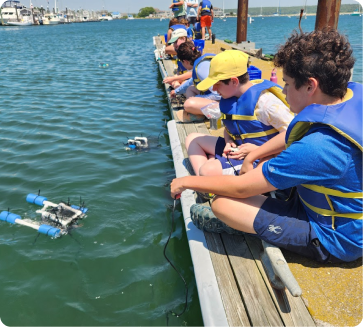
Eco Engineers: Campers look to nature for inspiration as they tackle real engineering challenges. They’ll design and test their own wind turbine and get hands‑on experience operating a Remote Operated Vehicle (ROV).
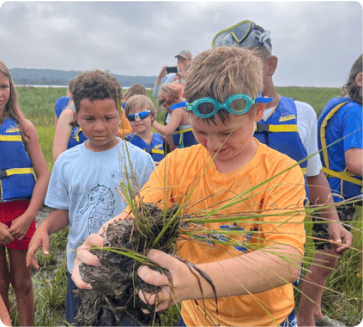
Hidden Habitats: Squish through the salt marsh, climb on the rocky shore, and comb through the beach as you explore a different habitat each day! Campers search for hidden creatures, investigate tide pools, and discover how each habitat supports unique plants and animals.
Animal Adaptations: Campers collect and observe marine animals from Long Island Sound and discover the unique adaptations that help them find food, survive predators, and thrive in their environment.
Art & Science: This camp blends creativity and discovery. Each day, campers explore the marine environment by boat, then connect with nature through journaling, art projects, habitat investigations, and water sampling. They’ll create 3D collages from found beach objects and use seine nets to catch nearshore fish—a perfect mix of art and science.
Week 1: June 22 – June 26 (Art & Science)
Week 2: June 29 – July 3 (Hidden Habitats)
Week 3: July 6 – July 10 (Animal Adaptations)
Week 4: July 13 – July 17 (ECO Engineers)
Week 6: July 27 – July 31 (Art & Science)
Week 7: August 3 – August 7 (Animal Adaptations)
Week 8: August 10 – August 14 (ECO Engineers)
- Backpack or drawstring bag
- Bathing suit (a one piece or tankini)
- Beach towel
- Sunscreen
- Refillable water bottle with name on it
- Water shoes (flip flops are not good water shoes)
- Dry shoes to change into
- Dry clothes to change into
- Sweatshirt or long sleeves for lab time

- Mask/Goggles
- Sunglasses
- Rain Gear
- Hat
- Notebook
- Book to read
- Insect repellent
- Cell phone/smart watches
- Valuables
- 8:30AM – Check-in
- 9:00 AM – Stow personal gear, gather science gear for the day
- 9:15 AM – Habitat exploration by skiff or research vessel
- 12:15 PM – Lunch in the field
- 1:15 PM – Art project or science experiment in classroom
- 3:00 PM – Team building/Group games
- 4:00 PM – Check-out
Undersea Technology Camp
Step into the world of ocean technology and marine engineering! Working in teams, campers design and build SeaPerch Remote Operated Vehicles (ROVs), then put their creations to the test in daily engineering challenges.
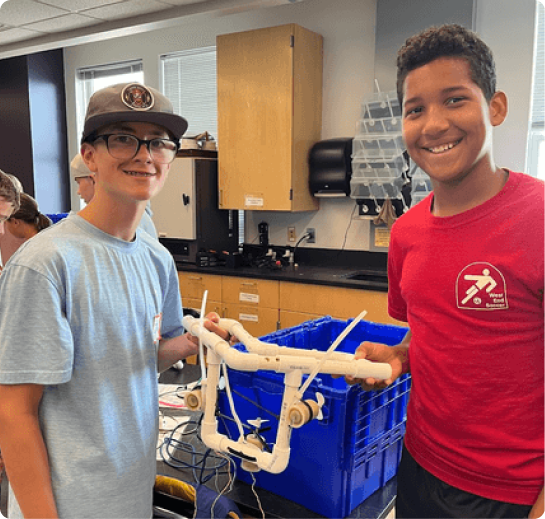
Step into the world of ocean technology and marine engineering! Campers use real scientific tools to study the brackish waters of Long Island Sound—collecting plankton, mapping the seafloor, and measuring water conditions at depth. Working in teams, they’ll design and build their own SeaPerch ROVs, then put them to the test in daily engineering challenges. From navigating an underwater obstacle course to cleaning a simulated polluted waterway, this camp is a good fit for problem‑solvers who love tech, teamwork, and discovery.
Week 2: June 29 – July 3 (Ages 11 – 13)
Week 4: July 13 – July 17 (Ages 11 – 13)
Week 7: August 3 – August 7 (Ages 11 – 13)
Week 9: August 17 – August 21 (Ages 11 – 13)
- Backpack or drawstring bag
- Bathing suit (a one piece or tankini)
- Beach towel
- Sunscreen
- Refillable water bottle with name on it
- Water shoes (flip flops are not good water shoes)
- Dry shoes to change into
- Dry clothes to change into
- Sweatshirt or long sleeves for lab time
- Mask/Goggles
- Sunglasses
- Rain Gear
- Hat
- Notebook
- Book to read
- Insect repellent
- Cell phones/smart watches
- Valuables
- 8:30 AM – Check-in
- 8:45 AM – Build/Modify SeaPerch ROV for Bottom Retrieval Challenge
- 9:30 AM – Complete Bottom Retrieval Challenge from the Avery Point pool
- 10:00 AM – Ride skiffs to local sandy beach: beach clean-up, seining
- 12:30 PM – Lunch in the field
- 1:00 PM – Current Drogue Study and Erosion Engineering Challenge
- 2:30 PM – Return to Project Oceanology, clean up
- 3:30 PM – Group Games/Science Notebooks
- 4:00 PM – Check-out
Mystic Aquarium Partnership Camp
Project Oceanology and Mystic Aquarium are teaming up to offer two great summer camps where campers will spend days at each facility learning about the residents of the Long Island Sound ecosystem and discovering ways to make a positive impact on our local environment.
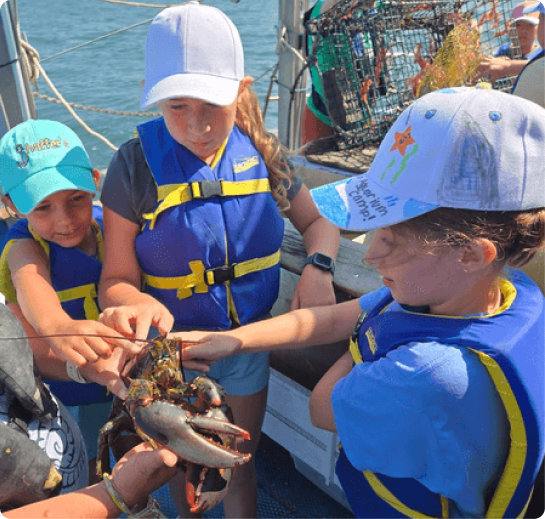
Marine Animals and their Environment (Grades 4-6):
Our goal is to create a camp environment where campers feel safe, supported, and excited to learn and grow. Research and best practices show that age-based camp programs, designed to meet the developmental needs of campers within similar age groups, provide a strong foundation for success.
Minimum age requirement: Campers must meet the age requirement on or before the first day of their camp week.
Campers age out of camp if they turn 18 before or during their selected camp week.
Environmental Conservation Camp (Grades 7-10):
Mystic Aquarium and Project Oceanology are teaming up to create an incredible camp! In this week-long program, campers participate in three days of research and exploration aboard Project Oceanology’s vessels to discover life in and around Long Island Sound. Then, they spend two days at Mystic Aquarium exploring the work being done to protect the many distinct species we have, gain experience while utilizing a microscope and learn about efforts to protect horseshoe crabs and pollinators. Campers spend time on the water, participate in experiments, meet with expert scientists, and even go behind-the-scenes to learn about the many conservation opportunities taking place locally.
Week 5: July 20 – July 24 (Grades 4 – 6)
Week 5: July 20 – July 24 (Grades 7 – 10)
- Backpack or drawstring bag
- Bathing suit (a one piece or tankini)
- Beach towel
- Sunscreen
- Refillable water bottle with name on it
- Water shoes (flip flops are not good water shoes)
- Dry shoes to change into
- Dry clothes to change into
- Sweatshirt or long sleeves for lab time
- Mask/Goggles
- Sunglasses
- Rain Gear
- Hat
- Notebook
- Book to read
- Insect repellent
- Cell phone/smart watches
- Valuables
- 8:30AM – Check-in
- 9:00 AM – Stow personal gear, gather science gear for the day
- 9:15 AM – Habitat exploration by skiff or research vessel
- 12:15 PM – Lunch in the field
- 1:15 PM – Art project or science experiment in classroom
- 3:00 PM – Team building/Group games
- 4:00 PM – Check-out
*Registration is through Mystic Aquarium
“Project Oceanology is amazing! I was so impressed with the level of communication, and the careful thought that went into all the safety planning. I felt totally comfortable sending my daughter there, knowing that you had clear and sensible protocols. The mix of structured and free exploration was terrific.”

Still have questions?
We want to help you and your family prepare for your week-long adventure. Learn everything you need to know to get ready for camp!